
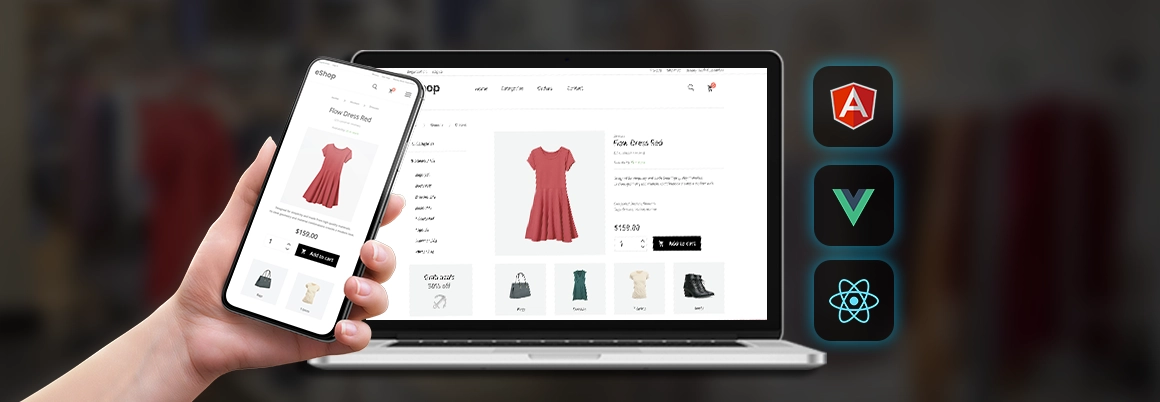
E-commerce businesses require a dynamic, responsive and competitive website. Choosing an appropriate front-end framework determines how your site scales, looks, and performs. Today’s front-end technologies offer modern solutions that allow businesses to create and build robust, user-friendly, online retail systems. Business opportunities for digital commerce can greatly benefit by leveraging these systems that are modern, efficient, and user-oriented.
The Current Industry Shift
With an escalating global e-commerce industry, a survey report from Statista on “Share of global mobile website traffic 2015-2024″ provides insight into new and engaging mobile-friendly technologies. It goes on to explain that enterprises require a holistic approach to mobile-friendly, responsive back-end technologies to ensure a perfect balance between user experience and ecommerce growth.
At the enterprise level, frameworks like React, Vue.js, and Angular provide robust front-end capabilities and support server-side rendering through companion tools, helping businesses build responsive and scalable e-commerce platforms for global markets.
Where is the Industry Headed?
As front-end frameworks continue to evolve, their latest advancements enable businesses to deliver real-time services, high-performance applications, and mobile-optimized user experiences.
The study on “Share of global mobile website traffic 2015-2024″ conducted by Statista mentions that approximately 55% of global e-commerce traffic originates from mobile devices. This emphasizes the need for mobile-first design solutions.
As businesses continue to adopt Progressive Web Apps (PWAs) or Server-Side Rendering (SSR), front-end frameworks are adapting to increase performance, improve security, and interface better with APIs and other services.
A survey on “The Most used web frameworks among developers worldwide 2024” carried out by Statista shows that Node.js and React are the most used frameworks within the developer community. More businesses are adopting React due to the rapid growth of the e-commerce sector. The framework’s flexibility and component-based design enable React to scale and improve the front-end of e-commerce sites efficiently.
Vue.js Adoption: Many small and medium-sized e-commerce platforms are adopting Vue.js because it is lightweight, improves performance, and is simple to use.
Angular’s Role in Enterprise E-commerce Solutions: The e-commerce sector for large and medium-sized businesses keeps growing, and the need for more advanced features increases. Angular is the framework of choice because it is scalable, has two-way data binding, and a comprehensive ecosystem.
Industries, Services, and Products Covered
E-commerce businesses are able to cover and operate in multiple geographic areas using modern frameworks:
- B2C E-Commerce : Businesses use modern frameworks to capture more customers digitally.
- B2B E-Commerce : Advanced frameworks simplify complex order management and automation of custom workflows.
- Subscription Services : Personalization is at the heart of modern businesses, and modern frameworks help tailor subscription services to clients’ needs.
- Digital Marketplaces : Multi-vendor platforms are often hosted on React-based or Angular-based frameworks due to the ease of using the frameworks’ modular nature.
These frameworks are essential for businesses that operate in sectors where the need for ever-changing data, real-time features, and high-level integration are crucial.
Technological Developments, Innovations, and Policy Changes
Rapid advancements in front-end technologies are reshaping the e-commerce landscape, enabling faster, more innovative, and secure user experiences. At the same time, evolving data privacy regulations and innovative architectural models influence how platforms are built and maintained.
Core Technologies Behind Modern Frameworks
React : Originally developed by Facebook, React is a component-based JavaScript library that builds fast and responsive user interfaces. Its virtual DOM and unidirectional data flow contribute significantly to performance optimization.
Vue.js : E-commerce websites can benefit from Vue.js’s simple structure and responsive features. It is lightweight and very easy to use, which makes it one of the most popular frameworks.
Angular : Angular is a full-featured framework created by Google. It is a type of scriptbased framework that finds application in large enterprises where a strong architecture and a wide range of tools are required.
Innovations Having Impact on Front-End Frameworks:
Progressive Web Apps (PWAs): Lets users access an app-like experience from the web, allows for use in offline mode, and retrieves data even on poor networks.
Server-Side Rendering (SSR): This is vital for ecommerce platforms that want their websites to be fast with higher page load speed. For ecommerce, rendered content on the server is a must.
Single-Page Application (SPAs): Allows users to access and use the site seamlessly with faster and smoother interactions without the page refresh.
Effect of Policy Changes:
Policy changes propelling data privacy for users on the web like GDPR and CCPA, mandate that businesses put in place safe and compliant solutions to secure the front end. Hence, modern front-end frameworks now have features that can protect and handle customer data with tools for cookies, user permissions, and encrypted data interchange.
Disruption and Future Development :
Headless commerce is the new trend that is changing the eye of enterprise on front-end development. This architecture allows greater speed with updates because the front end is separated from the back end. JavaScript technologies, such as React and Vue.js, are paving the way for this with their frameworks, as they let developers design the user interface based on preferences, independant of back-end logic.
Additionally, AI-powered personalization is changing the e-commerce space. With machine learning, front-end frameworks can now automatically suggest, price, and tailor all shopping and product offerings to the customer.
Market Shifts and Future Directions
In the evolving world of e-commerce, there is no doubt that the latest front-end development frameworks will be of great value. Look forward to improvements with:
AI-powered UI: Forecasting user actions and changing the content with machine learning.
Cross-platform participation: Continuing to unify mobile, web, and desktop through frameworks.
Voice Commerce: The need for interactive and voice-powered e-commerce sites that will interface with the front end of the system through voice will increase with the growth of voice assistants.
Conclusion
Get Smart Coders is aware of the need to choose the right front-end e-commerce frameworks to ensure the solution runs fast, is scalable, and user-friendly. We specialize in building React, Vue.js, and Angular-powered e-commerce frameworks, which are dynamic and can be adjusted to changing user needs and expectations.
For us, the right choice of front-end frameworks relies on the characteristics of the mobile and web traffic volume. We adopt React for greater web traffic and performance needs. With lower mobile traffic, we use Vue.js, and for complex and scaled mobile solutions that need heavy back-end work, we use Angular.
As mobile usage increases and AI continues to change e-commerce, we are enhancing mobile UX and conversion rates using the latest technologies.
With years of experience, Get Smart Coders is driven to help you build e-commerce platforms or mobile applications tailored to your unique enterprise needs to accelerate growth.
FAQ’s
Q1. Which of the following front-end frameworks is the most suited for an ecommerce business – React, Vue.js, or Angular?
For high-traffic websites, React is ideal and offers highly scalable. Vue.js is perfect for smaller and simpler projects due to its lightweight and simple framework. For highly complex and enterprise-grade applications, Angular is perfect due to its powerful frameworks.
Q2. What impact do modern frameworks have on a website’s mobile experience?
To give a more faster and responsive online experience on any device, we use these modern frameworks – like React, Vue.js, and Angular that incorporate mobile-first design, faster loading times through server-side rendering (SSR), and add more fluid interactions with Single Page Applications (SPAs) giving more responsive shopping experience.
Q3. Is it necessary to hire web developers with experience in progressive web applications (PWAs) and server-side rendering (SSR)?
Yes. If your goal is to have high performance, offline access, and better SEO, then it is a must. Web applications provide PWAs that create an experience like mobile applications, while SSR enhances the speed and visibility of web pages on search engines – both of which drive conversions for e-commerce.
Q4. How do you ensure your customers’ data privacy and security
Our front-end developers follow secure coding practices, implement user permission configurations, add consent banners, use data in-transit encryption, and comply with privacy laws, such as GDPR and CCPA.
 Prev
Prev



